

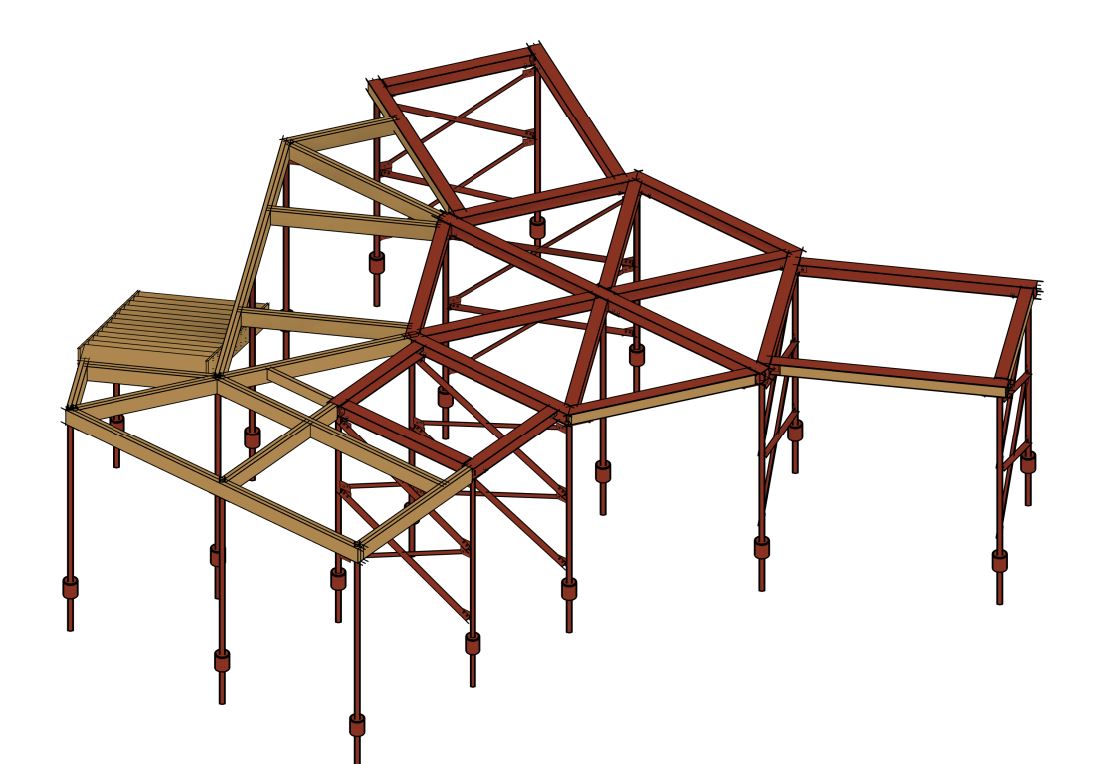
Ground Screws vs Helical Piles
Ground Screws
Ground screws are often marketed as an alternative to traditional concrete foundations and in some situations, they’re a perfectly reasonable choice. But it’s worth being clear about what they are from an engineering point of view.
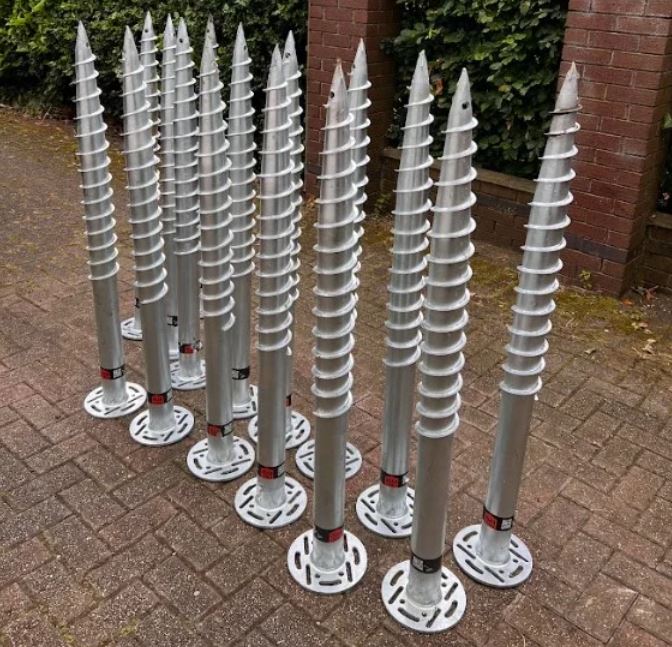
Image credit: Lux garden rooms
A ground screw is essentially a proprietary product.
It’s usually selected from a manufacturer’s range using standard load tables and basic assumptions about the ground conditions, rather than being designed specifically for the structure or the site.
There is usually:
- Limited or no project-specific design
- No verification of load capacity during installation
- An assumption that the ground conditions are suitable and consistent
This makes ground screws ideal for:
- Lightly loaded structures
- Temporary or non-critical applications
- Situations where speed and minimal disruption are priorities
From an engineering standpoint, they are a convenient solution but not a fully verified one.
Ground Screws vs Helical Piles
Helical Piles
Helical piles might look similar at first, but they’re a different thing altogether.
They’re not just selected from a range they’re designed to suit the structure and the ground they’re going into.
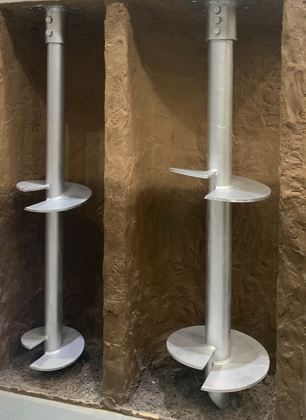
Each pile is:
- Engineered to suit the load requirements of the building
- Designed based on site-specific ground conditions
- Installed using controlled torque, which provides real-time verification of capacity
The helical plates (or flights) are not just there to “screw it in” they are critical structural elements that:
- Transfer load efficiently into competent strata
- Control settlement
- Provide predictable performance
This makes helical piles suitable for sites where:
- Poor or variable ground conditions
- Restricted site access
- Tree roots nearby
- High water tables
- Sloped or uneven site
- Retrofitting or underpinning
The Key Difference Between Screw Piles and Helical Piles
The distinction is straightforward:
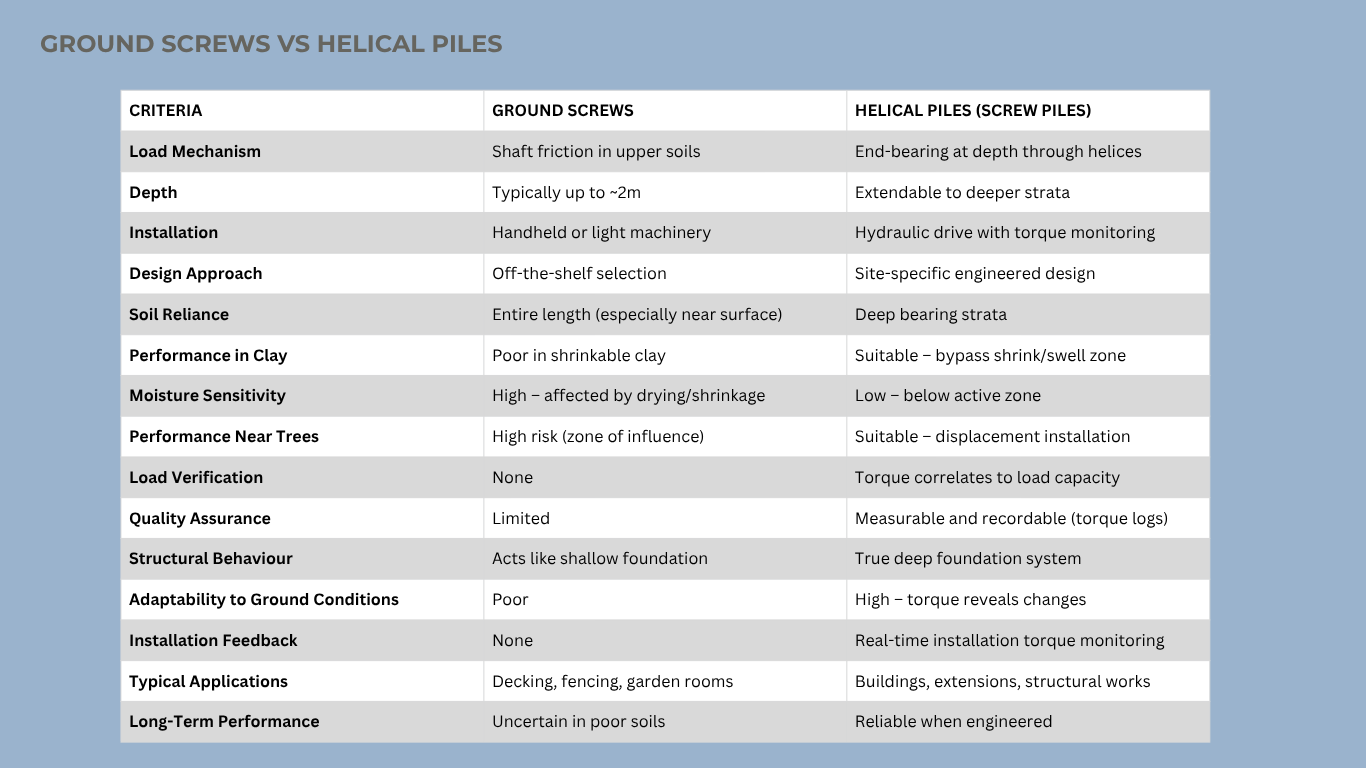
- Ground screws are selected from standard manufacturer data
- Helical piles are designed to suit the structure and the ground conditions
Why This Matters
The issue arises when the two are treated as interchangeable.
Using a ground screw in place of a designed foundation introduces uncertainty:
- Settlement behaviour is less predictable
- Load capacity is assumed rather than demonstrated
- Long-term performance depends heavily on ground variability
With helical piles, the approach is different:
- Capacity is derived from design and verified during installation
- Load transfer is taken into competent strata
- Performance is more predictable and measurable
Final Thought
For lightly loaded structures, ground screws can be a practical solution.
But once you’re dealing with a building, the foundation becomes a structural element.
At that point, it’s no longer about selecting a product it’s about designing a foundation system with known and verifiable performance.
