The Hidden Risks of Relying on Paper-Based Assessments

When planning a structural engineering project, cost-saving measures are always a priority.

Many professionals turn to desk studies as a way to reduce upfront expenses by gathering existing site data before committing to physical surveys.

While desk studies provide valuable insights, they also come with significant limitations. In contrast, an in-person survey conducted by a Chartered Structural Engineer offers a more accurate and reliable foundation for project planning.

So, do desk studies really cut costs, or do they risk leading to more expensive problems down the line?

The Limitations of Desk Studies

While desk studies are useful for preliminary research, they come with several disadvantages that can lead to costly oversights and project delays.

  1. Desk Studies Rely on Outdated or Incomplete Data

Desk studies depend on historical maps, geological surveys, environmental records, and past reports—but this information may be outdated or inaccurate.

Site conditions can change over time due to environmental factors, urban development, or unforeseen structural degradation. Relying solely on existing data can lead to miscalculations and unexpected issues during construction.

On this site we found a manhole onsite, covered by vegetation, which was in a different location to the local authority maps. We were able to model the drainage more accurately and adapt our design accordingly.

  1. Lack of On-Site Verification

A desk study does not provide a real-time assessment of a site’s actual condition. Many structural issues, such as cracks, settlement, water ingress, or hidden structural defects, can only be identified through an in-person survey.

Without direct observation, potential risks may be missed, leading to unforeseen complications and costly remedial work later.


During a site visit where the builder had begun works on the original design, we were able to identify some structural defects with the existing property roof, floor and brickwork walls which we were able to remediate in our design.


  1. Increased Risk of Design Flaws

Since desk studies do not involve physical measurements or site inspections, they often result in assumptions that may not reflect real-world conditions. Engineers designing based solely on desk study data may create plans that later require significant modifications when site realities do not match expectations. These redesigns can lead to delays, additional costs, and wasted resources.

  1. Desk Studies Can Give a False Sense of Security

Because desk studies provide theoretical insights, project stakeholders may believe they have a clear understanding of the site’s conditions. However, without a physical survey, unknown risks remain.

Unexpected ground conditions, unstable structures, or undetected underground services can create major problems once construction begins—often resulting in more expensive corrective measures than if an in-person survey had been conducted from the outset.

On this site there were lots of trees within close proximity of each other. The tree type effects the proposed foundation depths.

We located the stump of a coniferous tree on this site which had recently been removed at the location of our proposed extension.

We were able to adapt the design the foundations to mitigate the clay / heave potential of the soils, with a stepped design related to the vicinity of the tree to save the required excavation / concrete required. (Initial scheme – now a piled raft design)


The Advantages of an In-Person Survey by a Chartered Structural Engineer

  1. Accurate, Real-Time Data Collection

A site visit allows engineers to physically assess the property, taking precise measurements, identifying defects, and noting site-specific constraints that desk studies cannot reveal. This ensures that the structural design is based on actual, up-to-date conditions.

  1. Identification of Hidden Structural Risks

Many structural problems—such as subsidence, foundation failures, and material deterioration—are not documented in historical records. A trained engineer can spot these issues early, preventing costly surprises during construction.

  1. Improved Design Accuracy and Efficiency

With a thorough on-site survey, engineers can develop designs that are realistic, site-specific, and less likely to require later modifications. This leads to smoother project execution and fewer unexpected costs.

  1. Reduction in Long-Term Costs and Delays

Although an in-person survey has an upfront cost, it ultimately saves money by preventing expensive remedial work and reducing the likelihood of design changes during construction.


Conclusion: Balancing Cost and Risk

While desk studies can be useful for initial research, they should never be relied upon as the sole basis for a structural engineering project.

Their limitations

  • outdated data
  • lack of on-site verification, and
  • the potential for design errors

can lead to costly problems down the line.

Investing in an in-person survey by a Chartered Structural Engineer ensures a more accurate assessment, reducing risks and preventing expensive surprises.

Ultimately, while desk studies may seem like a cost-cutting measure at first glance, a well-executed site survey is the smarter investment in the long run. If you want to avoid unnecessary expenses and ensure a structurally sound project, an in-person survey is the way to go.

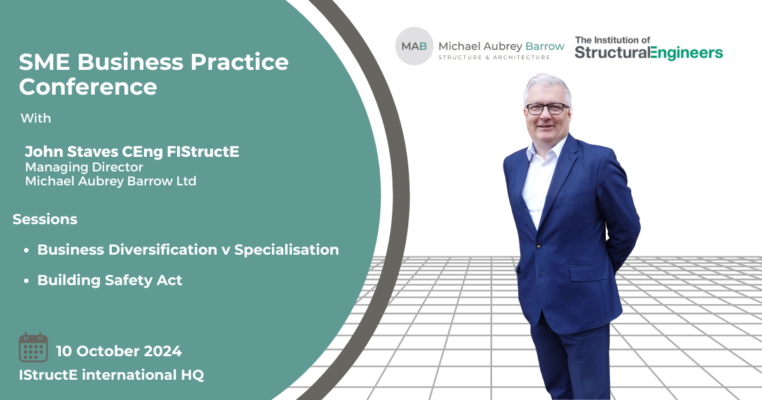
On October 10th, 2024, the prestigious SME Business Practice Conference took place at IStructE International HQ, gathering industry leaders to explore key strategies for navigating business challenges within small to medium enterprises (SMEs).

Our Managing Director, John Staves, was a featured speaker, sharing his insights on business diversification—an area where his experience has proven invaluable.

john staves

Business Diversification VS Specialisation

John participated in Session 2: Business Strategy, alongside notable figures such as Bola Ogunmefun, Director of Tisserin Engineers. While Bola focused on the merits of business specialisation, John shed light on the benefits of diversification.

Drawing from his leadership at Michael Aubrey Barrow Ltd, he explained how expanding service offerings—particularly into architecture for residential schemes—enabled the firm to grow and adapt to client needs.

John highlighted the importance of being attuned to market demands and how listening to clients can uncover new opportunities. By diversifying into architecture, Michael Aubrey Barrow has been able to broaden its service scope while maintaining the core focus on structural engineering.

His talk emphasised the strategic balance needed to diversify successfully without compromising the business’s core strengths, helping it remain resilient during periods of economic uncertainty.

john staves


Building Safety Act

Later in the day, John returned to the stage during Session 4, co-presenting with Patrick Hayes on the Building Safety Act.

Here, he provided vital guidance on how the Act affects SMEs and the competencies required for firms to remain compliant. As Chair of IStructE Ltd and a former IStructE Board Member, John has been at the forefront of these discussions, making him a key authority on how these regulatory changes impact day-to-day operations.


John’s contributions to the conference were well received, reinforcing his position as a leader in the structural engineering community. His deep understanding of both the technical and business aspects of running a practice ensures that Michael Aubrey Barrow continues to thrive, even in challenging environments.

By engaging in critical conversations on both business diversification and regulatory compliance, John further established his expertise in guiding SMEs through evolving industry landscapes.