Falling Revenues As The Impact of the Comms Code Bites

If you own or manage a property portfolio that includes telecommunications tenants you must be having sleepless nights worrying about the loss of revenue.

What’s Changed?

The New Electronic Communications Code (the “Comms Code”) allows for the mobile operators to use “Code Powers” to access sites and demand substantially lower rents at renewal – in some cases 95% lower rents and in one case 97.2% reduction.

What Can You Do To Protect Your Revenue Stream?

We work with property owners to drive a fairer position between operator and landowner.Our business model allows us to offer substantially more consideration and compensation than code valuations.
Recent Case Study

Working with one Public Body, with multiple sites up for renewal, we have successfully maintained revenue at £54,500 in the face of a renewal offer of £5,000!

Who Are Michael Aubrey Telecoms*?

We are a Wireless Infrastructure Provider with 30 years industry experience, firstly rolling out networks, over the last 20 years working exclusively for site owners. 


We have been awarded code powers by Ofcom to develop and extend an independent network of sites for use by multiple network operators. 


Who Do We Work With?

We work exclusively for Local Authorities and Blue light organisations such as the Fire and Police service.




Book A Free 15 Minute Consultation

Talk to one of our experts today and discover how we can help you protect your revenue. 

Contact Us

* Michael Aubrey Telecoms is a brand name of Michael Aubrey Partnership

The Electronic Communications Code (the Comms Code) is a set of rights that are designed to make it easier for network operators to facilitate the installation and maintenance of electronic communications networks across the UK.

What Is The New Telecoms Code (Comms Code)?

The Code provides for telecoms operators who are granted rights under the Code, to install and operate telecommunications apparatus such as telecoms masts and fibre optic cables, on land and buildings.

Who Does The New Comms Code Affect?

Property owners who have leases (licences) with mobile operators to install and operate telecoms equipment on their land and rooftops.

How Will The New Telecoms Code Affect UK Property Owners’ Rental Incomes?

When current leases expire the negotiating position taken by operators with code rights is simple; take our very low offer or we will go to tribunal and the valuation rules set out will derive an even lower ‘rent’.

What Do Code Powers Allow

Operators To Do?

New rights make it easier for telecommunications operators to deploy and maintain their infrastructure and it gives them new automatic rights to upgrade and share apparatus.

In summary, the new code will allow the operators to

  1. force a reduction in rental income, as the change in the basis of valuation, will move to a “no scheme” rule reflecting the underlying value of the land.
  2. Operators will be allowed to install telecoms equipment on, under or over land and
  3. gain access to the land to inspect and maintain the equipment.

Click here to read the detail.


What’s Happening In The Market At The Moment?

Where leases are coming up for renewal, operators and landlords aren’t able to agree terms which is leading to stagnation in the marketplace.

Up to a 95% Loss of Income for Property Owners

Property owners are seeing mobile operators offering significantly lower rents than have been previously agreed and the Code has been written to allow operators to force their way onto sites they need at negligible cost.

We are currently managing sites across the UK for numerous “blue light” organisations, Police and Fire Authorities.

Typically where leases have come up for renewal, we are seeing offers of £500 per annum where previous rents passing were £5k, £10k even £15k per annum!

How Can Property Owners Protect Their Rental Incomes?

Our business model allows us to offer substantially more than code valuations, by adopting a fairer position between operator and landowner.

Extended rights allow sub-letting/sharing and upgrading of sites for no additional payment to you as the landowner. 

Our model addresses this. Click here to read more.

Are you about to lose 95% of your income?

Register for the 15-minute consultation that will help you protect your income.

Register NOW

Our third speaker for the day was John Staves, Managing Director at Michael Aubrey Partnership. John is a Chartered Structural Engineer and has worked in the Telecoms industry for over 30 years.

Specialist Telecoms Knowledge

He could be described as a “poacher turned game keeper” as initially, John’s specialist knowledge was gained through working with the mobile operators – he understands the Telecoms market and it gives Michael Aubrey Partnership a unique stand point when representing the Fire and Police Services – providing them with independent, unbiased advice.

John opened his presentation talking about what the drivers were for structural safety, with reference to BS8210 2012. He talked about how British Standards are moving away from being prescriptive to acting more as a “prompt” to think. Allowing you to set out a framework – more of a risk management approach where you;

  • identify hazards
  • identify who could be at risk
  • eliminate, reduce or control the hazard and
  • train those affected by it

Telecoms Condition Surveys

John shared his experience talking through a recent case study where Michael Aubrey Partnership were asked to undertake detailed condition surveys on 65+ drill towers and ancillary structures across the UK.

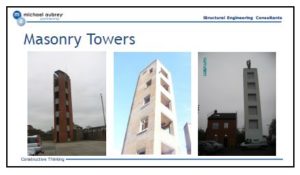
Masonry drill tower


Using a traffic light system of categorisation he was able to help the Fire Authorities identify which structures were in urgent need of repair.

  • 13% of drill towers were identified as being “red” and having defects so serious that they required immediate action
  • Over half of drill towers required maintenance within 12 months

Maintenance Schedule

Ordered by priority, a maintenance schedule was generated which allowed the Fire Authorities to plan their maintenance project around this.

Economies of scale were able to be achieved with contractors, as maintenance programs could be carried out in a methodical, planned way.

Importance of Routine Maintenance

John also talked about the importance of regular routine maintenance.

Whilst unexpected deterioration, damage or failures may still occur, with a regular maintenance cycle you will minimise the need for major refurbishment and repairs

Structures deteriorate over time and will continue to deteriorate if regular routine maintenance is not carried out. Minor repairs and preventative maintenance, should minimise future problems and ensure your structures remain in peak condition.

In summary;

  • Adopt a risk based approach
  • Set your maintenance policy in line with the British Standard BS8210: 2012
  • Adopt a tier based approach with regular inspections and reporting by users, annual reporting by your estates department and specialised surveys every 3 years

When was the last time you carried out a detailed inspection of your property portfolio? If you did, would you find your sites in the Red or Green category?