
A recent post on LinkedIn suggested that contractors should use their “common sense” and just get on with it, rather than referring back to the structural engineer when something on site doesn’t match the drawings.

On the surface, it sounds practical. After all, contractors are on site every day, they know the building, and they understand how things fit together in reality. But there’s a problem with that line of thinking: common sense can’t calculate load paths.

The reality behind the drawings

As structural engineers, every design we produce is based on assumptions.

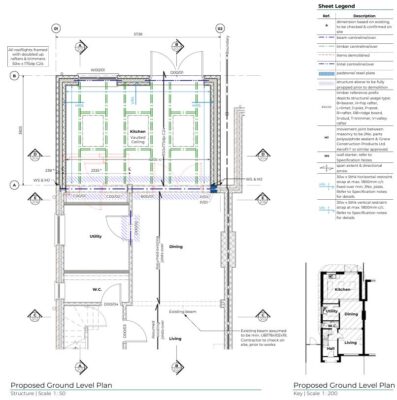
For example, when walls are removed, we may assume that an existing steel beam lies hidden behind plasterboard. We can’t always know what that beam was originally designed to carry, but we can calculate exactly what it needs to support going forward.

That’s why our drawings often include notes such as:
“This beam needs to be this size, or equivalent. Contractor to confirm.”

This instruction isn’t vague, it’s deliberate. It means that if the contractor uncovers something different from what we assumed, their next step is to come back to the designer.

Typical internal alterations

Why it matters

To the untrained eye, a beam of similar depth might look “close enough.” But here’s the danger: not all beams are created equal. A 152UC, a 152UB, and a 150-deep channel may look nearly identical, yet their performance can vary significantly.

One section may be prone to lateral torsional buckling, another might lack the stiffness required, and another could be more than adequate. The only way to know for sure is through design calculations. If a contractor relies on “common sense” to make that call, the risk is very real: overloading, hidden weaknesses, and ultimately, potential failure.

Clarity beats assumption

The Building Safety Act is unambiguous: the designer is responsible for the design. Contractors aren’t expected to carry that responsibility and shouldn’t have to.

The correct process is clear:

  1. Engineers make their assumptions explicit.
  2. Contractors confirm conditions on site.
  3. Any discrepancies are referred back to the structural engineer for reassessment.

This isn’t red tape. It’s safety. 

A beam isn’t safe simply because it “looks the right depth.”

Shape, section, restraint, and load conditions all play a role.


Contractors bring enormous value through their skill and experience on site. But they should never be left to make structural design decisions in isolation.

Common sense has its place, but when it comes to structural safety, clarity and collaboration will always beat assumption.

CDM & Building Safety Act CPD at Bracknell Forest Council

What do Principal Designers really need to know about CDM and the Building Safety Act – and how do these regulations shape safer construction?

That’s exactly what was explored when John Staves, CEng FIStructE, Chartered Structural Engineer, visited Bracknell Forest Council to deliver a dynamic and insightful CPD workshop tailored to the real-world challenges of today’s built environment.

CDM & Building Safety Act

The session brought together property surveyors from Bracknell Forest Council to explore how the roles and responsibilities of duty holders are evolving under these two significant pieces of legislation.

John’s practical approach and deep knowledge helped make complex regulatory changes easier to understand and apply.

John guided attendees through the evolution of the CDM Regulations, from the introduction of Planning Supervisors in 1994 to today’s expanded responsibilities of the Principal Designer – now further shaped by the Building Safety Act.

Proactive Risk Management

John highlighted the growing emphasis on proactive risk management, clear communication, and genuine collaboration between duty holders as essential tools for improving construction safety.

The Building Safety Act was explored in this context, with particular focus on its drive for safer design and stronger accountability – for all projects regulated by the Building Regulations.

Although driven by Higher-Risk Buildings (HRBs), the BSA presentation and discussion concentrated on non-HRB projects which form the majority of construction work.

John broke down the new competency requirements and opened up discussion around what these changes mean for professionals navigating the current regulatory landscape.

Raising Safety Standards

The session wrapped up with plenty of practical takeaways and left the team feeling informed, empowered, and committed to raising safety standards across their work.

“The event was well organised with good notes and Johns unbiased, knowledgeable presentation helped to unravel a confusing subject giving us confidence on how to proceed and keep within CDM and BSA regulations”. Julian, Bracknell Forest Council


Unsure about your responsibilities or competency under the Building Safety Act?

If you’re navigating new duties or just want clarity on what the changes mean for your role, we’re here to help.
Drop us a message today and let’s talk through your next steps with confidence.

Email us at: support@mapl.co.uk

For clients, selecting the right Structural Engineer can make or break a project. But with the market flooded by individuals with varying levels of qualifications and experience, how can you tell the difference between an expert and someone unqualified to make critical structural decisions?

  • The hidden costs of errors

The truth is, a lack of expertise may not be evident—until it’s too late. Poorly designed structures can lead to increased construction costs, delays, or even safety risks.

  • Lower fees seem appealing

On paper, less experienced engineers may seem appealing due to lower fees, but the hidden costs of errors, redesigns, or failed inspections can far outweigh any initial savings.

  • Anticipate challenges before they arise

Chartered Structural Engineers bring invaluable benefits to your project; 

  • Years of training
  • accreditation
  • hands-on experience and
  • ensure designs that are not only compliant with building regulations but also optimised for cost-efficiency and long-term durability.

Qualified structural engineers anticipate challenges before they arise, offering innovative solutions that will save you time and money.

What qualifications should you look for?

When appointing a structural engineer, you should look for the following qualifications and attributes to ensure you hire a competent and trustworthy professional:

Formal Education and Accreditation

Professional Certifications

  • Look for Chartered status, such as CEng MIStructE (member of the Institution of Structural Engineers or CEng FIStructE (fellow of the Institution of Structural Engineers)  which demonstrates advanced qualifications and experience way beyond Masters Graduate.

Relevant Experience

  • Experience with similar projects, whether it’s residential, commercial, or industrial structures.
  • Expertise in addressing the specific challenges of your project (e.g., structural assessments, or defect diagnosis.

Knowledge of Building Regulations / Building Safety Act

  • Familiarity with building regulations and compliance requirements to ensure safety and legal adherence.
  • The Building Safety Act requires Clients to appoint competent designers

Communication and Collaboration Skills

  • A good structural engineer should be able to clearly explain technical concepts and work effectively with property owners, architects and contractors

Reputation and References

  • Positive reviews, recommendations, or case studies from previous clients.
  • Examples of completed projects that align with your needs.

Professional Insurance

  • Ensure the engineer carries Professional Indemnity Insurance, which protects you in case of errors or omissions in their work. What level of indemnity is provided? Is the cover adequate for your project?

Working with experienced professionals ensures confidence in your project’s success. Clients can rely on solutions that are both structurally sound and financially sustainable.

Don’t gamble on one of the biggest investments you’ll make; choose a structural engineer who can deliver expertise, precision, and reliability.

Feedback

Have you hired a structural engineer before? What was your experience like? Did you feel you received good value, or did the service leave you disappointed?

We’d love to hear about your experience …

On October 10th, 2024, the prestigious SME Business Practice Conference took place at IStructE International HQ, gathering industry leaders to explore key strategies for navigating business challenges within small to medium enterprises (SMEs).

Our Managing Director, John Staves, was a featured speaker, sharing his insights on business diversification—an area where his experience has proven invaluable.

john staves

Business Diversification VS Specialisation

John participated in Session 2: Business Strategy, alongside notable figures such as Bola Ogunmefun, Director of Tisserin Engineers. While Bola focused on the merits of business specialisation, John shed light on the benefits of diversification.

Drawing from his leadership at Michael Aubrey Barrow Ltd, he explained how expanding service offerings—particularly into architecture for residential schemes—enabled the firm to grow and adapt to client needs.

John highlighted the importance of being attuned to market demands and how listening to clients can uncover new opportunities. By diversifying into architecture, Michael Aubrey Barrow has been able to broaden its service scope while maintaining the core focus on structural engineering.

His talk emphasised the strategic balance needed to diversify successfully without compromising the business’s core strengths, helping it remain resilient during periods of economic uncertainty.

john staves


Building Safety Act

Later in the day, John returned to the stage during Session 4, co-presenting with Patrick Hayes on the Building Safety Act.

Here, he provided vital guidance on how the Act affects SMEs and the competencies required for firms to remain compliant. As Chair of IStructE Ltd and a former IStructE Board Member, John has been at the forefront of these discussions, making him a key authority on how these regulatory changes impact day-to-day operations.


John’s contributions to the conference were well received, reinforcing his position as a leader in the structural engineering community. His deep understanding of both the technical and business aspects of running a practice ensures that Michael Aubrey Barrow continues to thrive, even in challenging environments.

By engaging in critical conversations on both business diversification and regulatory compliance, John further established his expertise in guiding SMEs through evolving industry landscapes.

The Building Safety Act is part of the building safety legislation produced in the wake of the 2017 Grenfell Tower disaster.

It’s aim is to;

  • Enhance safety standards
  • Ensure accountability
  • Maintain thorough documentation throughout a building’s lifecycle

The Building Safety Act for Homeowners – Does the Building Safety Act apply to you and your project?

If you are undertaking works that requires Building Regulations approval – Yes absolutely!

There is a misconception that the Building Safety Act only applies to high rise buildings – this is not the case. It applies to ALL construction projects where you have to apply for Building Regulations approval.

The Building Safety Act will change the way buildings are designed, constructed, and managed.

The Act enables the introduction of new regulations covering the competence of all those who undertake building work with new statutory roles for Designers and Contractors on all projects.

Who are duty holders?

  • clients (homeowners, developers, employers)
  • designers
  • principal designers
  • contractors and
  • principal contractors

What does it mean for you as a homeowner?

As a client (dutyholder), you are legally responsible for:

  • Appointing competent professionals to design and build your project.
  • Sharing relevant information related to your project.

What you need to do

When a building regulations application is submitted, you (the client and homeowner) have to declare who is taking on the principal designer duties – you have to be confident they are a competent designer.

Similarly, when you appoint a builder as principal contractor then you need to be confident they are a competent builder.

Both need to deliver your project such that it complies with the Building Regulations..


Typically, your designer will serve as the Principal Designer, and your builder will act as the Principal Contractor.


The changing role of Building Control

Building Control will no longer be able to advise how to comply with Building Regulations – it will be a simple

  • yes it’s compliant or 
  • No it’s not compliant– this applies at plan checking stage and on site

It is up to the competent designer to produce a compliant design and the competent builder to build to the approved design.

Enforcement and Penalties

A breach of duties by any dutyholder is a criminal offence. Failure of a duty holder to carry out their duties will be addressed via fines and a custodial sentence up to 2 years.

Once building work is complete

The dutyholders (Client, Principal Designer and Principal Contractor) are to provide a signed compliance declaration within five days of completion of the work confirming:

  • To the best of your (the client’s) knowledge the work complies with the Building Regulations.
  • The Principal Designer and Contractor both have to sign to say they have fulfilled their duties.

Potential pitfall: When a builder wants to make a change to the approved design

If there are design changes from the information declared as compliant by the Principal Designer (and approved by Building Control in their checking role) a competent designer needs to confirm that the design remains compliant.

You (the client) would be responsible for providing the relevant information or seeking assistance (from the Principal Designer) with the design element. 

Alternatively if you felt your builder was a competent designer you would need to declare a change of dutyholder and assign your builder as the new Principal Designer.

What happens once the build is finished?

Before Building control will carry out a final completion inspection, the client, the Principal designer and Principal contractor have to sign a “declaration of compliance” to say they are happy that they have carried out their duties under the act and the build is compliant with building regulations.

What happens if I can’t do this?

Building Control will not be able to issue a completion certificate, which may be an issue when you come to sell your property.

Want to find out more?

Check out the government guidance by clicking here.

If you are thinking of a project (around the Berkshire area) and need advice, please drop us an email at:- support@mapl.co.uk

On Tuesday 21 May 2024 the Institution of Structural Engineers are hosting an interactive panel discussion on the Building Safety Act in practice – John Staves our Managing Director will be speaking at this event.

Here are the details:-

April 2024 marks two years since the Building Safety Act established a new and enhanced regulatory regime for building safety and construction products. It has reshaped responsibilities and systems for everyone involved in designing, constructing, and managing Higher Risk Buildings (HRBs).

Join John and the interactive panel where you will have the opportunity to ask the expert panel your questions on:

  • Building control regime
  • Gateways
  • Golden thread
  • Safety cases
  • Impact on small domestic projects

Reasons to attend

  • Gain a deeper understanding of how the Building Safety Act affects your duties & liabilities and strategies for compliance
  • Acquire practical knowledge on implementing the Building Safety Act in real-world scenarios
  • Explore the implications of the new regime for HRBs and its broader impact on the industry
  • Discover how the Building Safety Act influences various projects, including industrial and small domestic projects

Chair, Victoria Martin

Speakers:-

  • Gavin McLachlan, Associate, Conisbee
  • John Leach, Director, Buildings+Places at AECOM
  • Mark Pundsack, Assistant District Surveyor
  • Mark Snelling, Managing Director, Safetymark Consultancy Services
  • John Staves, Managing Director, Michael Aubrey Barrow

For more information and details how to book your place (it’s free!)

https://www.istructe.org/events/hq/2024/building-safety-act/

totenham hotspur


From the moment we stepped foot into the iconic Tottenham Hotspur Stadium in London on October 17, 2023, the day was filled with insights, connections, and inspiration.


Keynote Speaker: Dame Judith Hackitt

Dame Judith Hackitt’s return as the keynote speaker was a highlight that set the tone for the entire event.

Her expertise in building safety, especially as the former chair of the Independent Review of Building Regulations and Fire Safety, was evident as she delved into the intricacies of the Building Safety Act. It was an illuminating experience, shedding light on how the Act would impact our businesses.


judith hackitt


Learning and Networking

Throughout the day, we had the privilege of exploring the latest trends in building safety, sustainability, and digital transformation, including the integration of AI technology. The schedule brimmed with guest speakers, each sharing their unique industry insights and expertise. The opportunity to network with construction professionals and fellow attendees provided a chance to exchange ideas and forge meaningful connections.

In conclusion, the Construction Leaders’ Summit 2023 was a day well spent. It left us informed, inspired, and connected, and we left with a profound sense of the current and future landscape of the construction industry. If you’re an architect, specifier, or building product manufacturer, this event is a must-attend. We’re eagerly looking forward to future opportunities like this, where we can collectively shape the future of construction.