Temporary Works

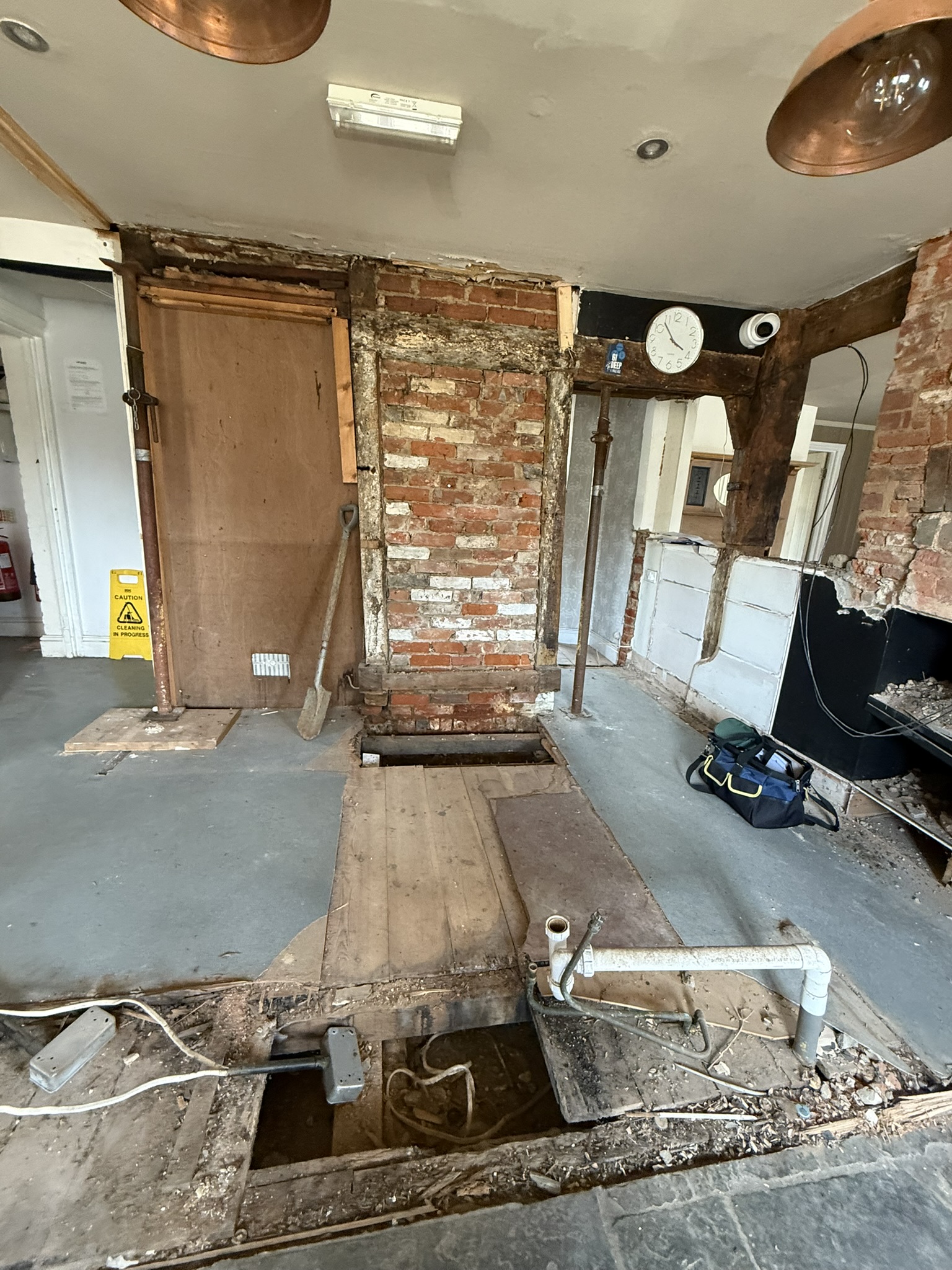
When we were approached by the team working on a Grade II listed pub, the project already had a structural engineer overseeing the permanent works design.

But there was one problem; no one wanted to take on the temporary works.

For a building with such significant heritage value and real constraints on what could and couldn’t be touched, temporary works weren’t just a technical requirement. They were a risk-management exercise, a heritage-sensitive responsibility, and a structural puzzle all in one.

And that’s exactly the type of challenge we love.

The Challenge: Support the Structure Without Damaging It

Because the building was listed, the contractor needed temporary support that:

  • avoided damage to the historic fabric
  • minimised the physical impact on the structure
  • adapted to tight space and access constraints
  • kept the workforce safe during all phases of construction

The existing structural engineer had already designed the permanent works but didn’t want to take responsibility for the more complex temporary works design.

That’s where our team stepped in.

Our First Step: Review, Assess, and Re-Think

Before putting pencil to paper, we:

  • reviewed the permanent works design from the existing engineer
  • carried out our own structural assessment and load calculations
  • considered how the temporary works would interact with the permanent solution
  • identified potential risks that could affect heritage elements

Temporary works shouldn’t ever be a bolt-on. They need to work with the permanent design, not against it.


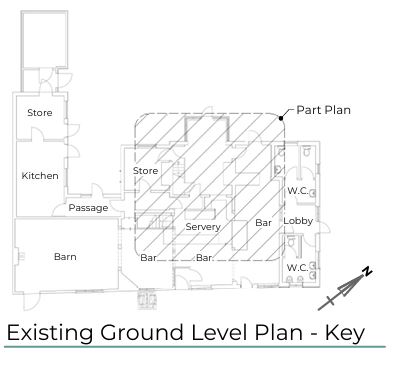
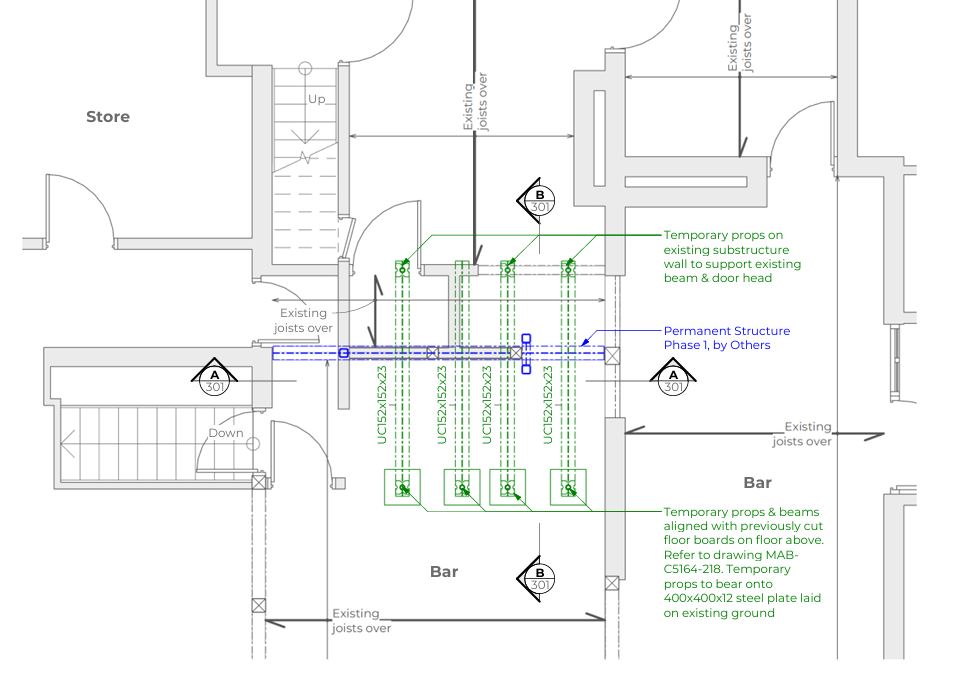
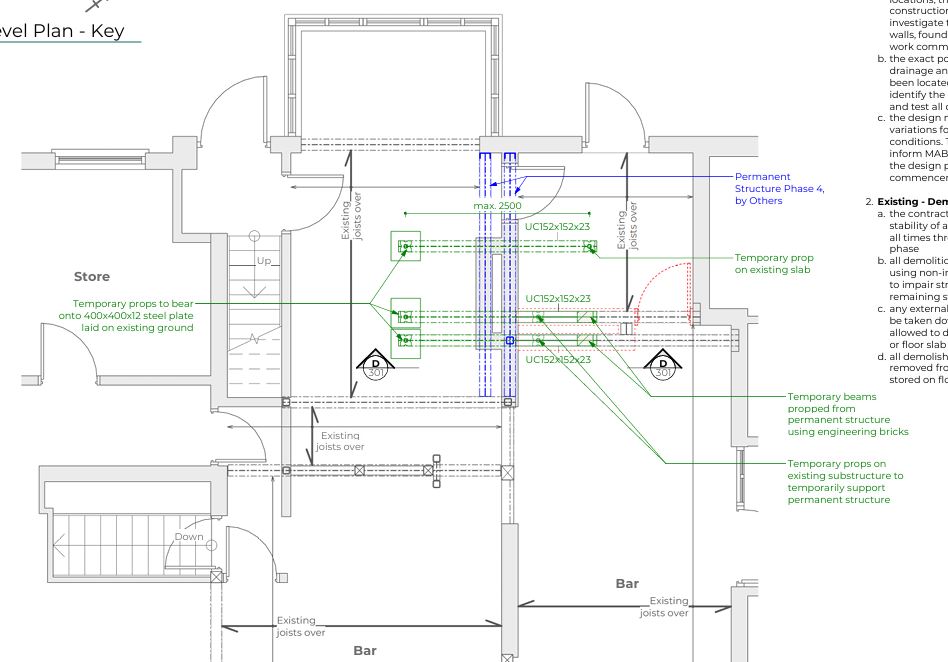
Phase 1: Temporary works design

Next: On-Site Discussions and Phasing Plan

Temporary works only succeed when the design reflects the reality of what’s happening on site. So we met the contractor on site to walk through the job, identify constraints, and talk sequencing.

Together, we developed a clear, safe approach to support the structure across four distinct phases, ensuring each stage:

  • maintained stability
  • protected historic features
  • allowed safe access
  • avoided unnecessary disruption
  • aligned perfectly with the contractor’s construction schedule

By thinking through the entire sequence, we allowed the contractor to progress confidently without stop–start complications.

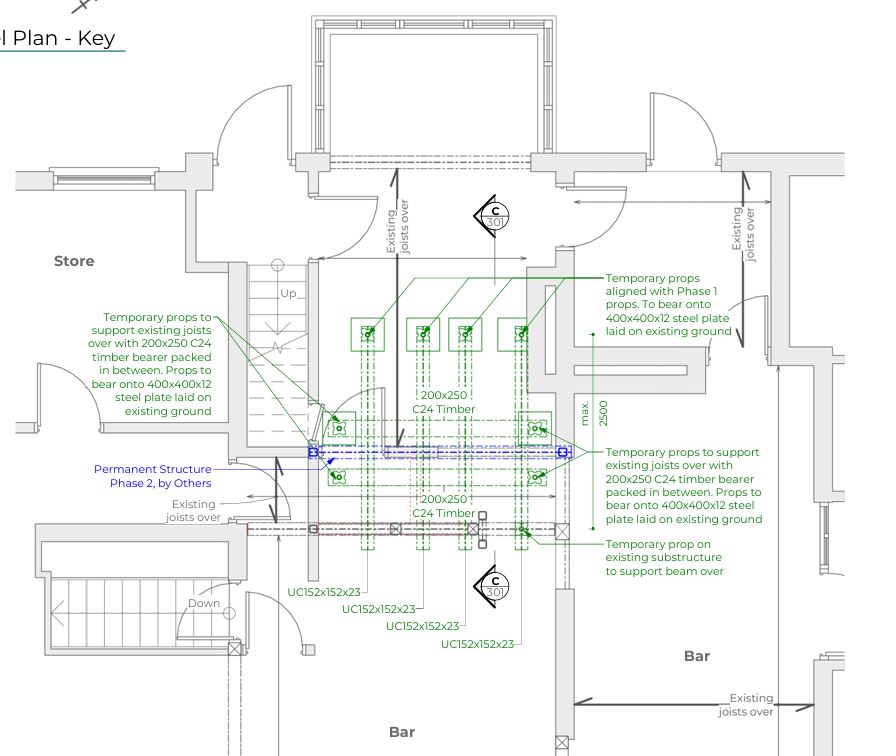
Phase 2: Temporary works design


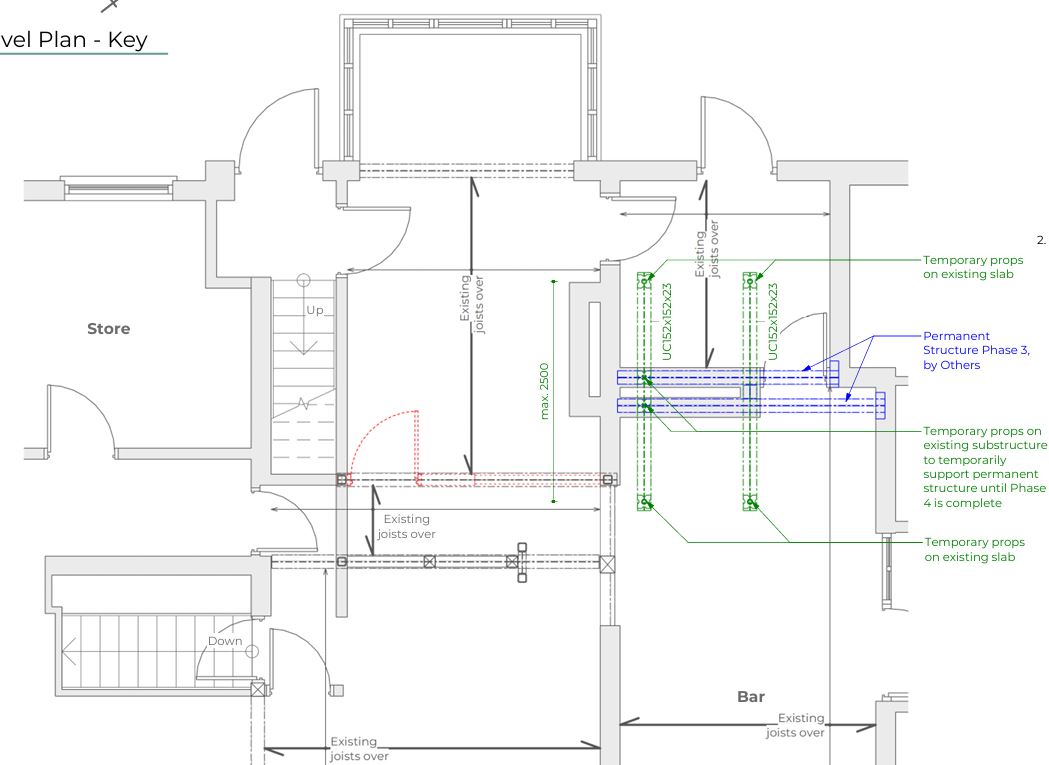
Phase 3: Temporary works design


Phase 4: Temporary works design

A Successful Outcome and a Chance to Celebrate

The project was a complete success.

The temporary works performed exactly as intended, supporting the structure, protecting the heritage fabric, and enabling the permanent works to be delivered safely and smoothly.

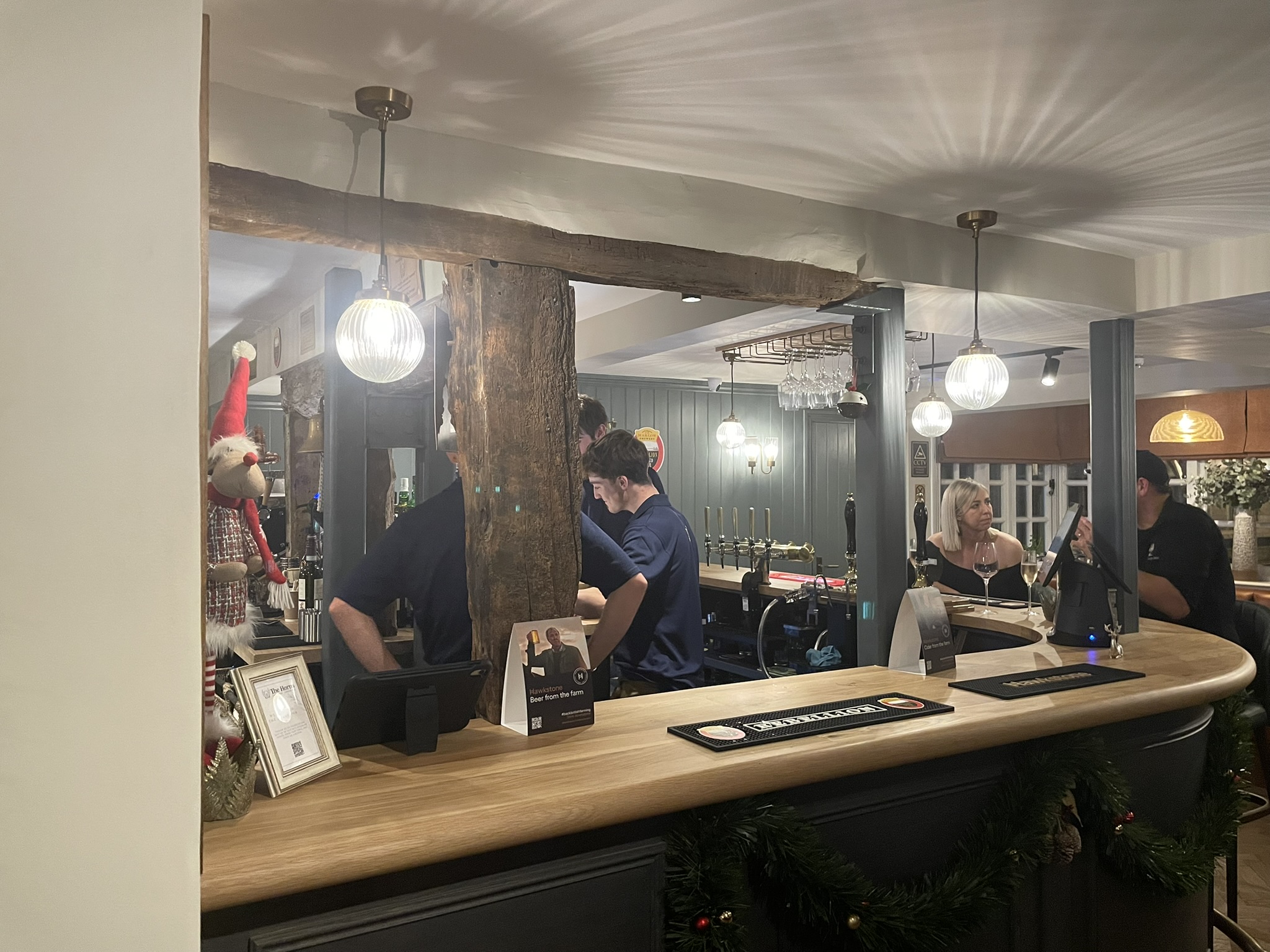
Last week, we were delighted to attend the pub’s reopening with Clare Truman, the heritage Architect who supported the project so thoughtfully from beginning to end.


Seeing the building sensitively restored, bustling with life again, and knowing we helped protect that history felt like a proud moment for the entire team.


Why Contractors Come to Us for Temporary Works

Permanent works engineers often don’t want the additional liability of temporary works design and we understand why.

Temporary works require:

  • rapid decision-making
  • deep understanding of construction sequencing
  • problem-solving in imperfect site conditions
  • flexible, adaptive design thinking

That’s where we specialise.

For contractors, this means they get designs that are not only structurally sound but also buildable, safe, and aligned with how the site actually works.


Get In Touch

If you’re planning a project where temporary works will play a critical role, we’d be happy to help. Get in touch to discuss your requirements. Call us on 0118 962 9666

Today I’m talking to Andrew Wiggett, one of our latest Structural Engineers to pass his Chartered exams.

Why Did You Choose To Study Structural Engineering?

When I was a school I didn’t really know what I wanted to do.

I chose the A levels that were interesting and “do-able” – Maths, further maths and physics and chemistry AS

I didn’t know what engineering was, or that you could do a degree in it

I thought I was going to do a Physics degree, or I looked at Medicine – but that was an idea that died out pretty quick!

In lower 6th form someone suggested looking at Engineering, I thought that’s a good idea – this is what I pictured physics to be like.


I did a general engineering degree at Cambridge University – 4 year Masters

My best module in first year was structures and materials – my two favourite subjects. I tried to avoid pure Maths, but there was a lot of this.


What Do You Like About Being An Engineer?

It’s a varied job, with lots of projects on the go at the same time.

I’m glad that none of my projects take too long, I wouldn’t like to be working on a project that had a two year deadline .. I wouldn’t know where to begin with that. Whereas twenty things to do in the next month is a lot more interesting.

Any Downsides To Structural Engineering?

Lack of protection of the name “Engineer” A friend said once they did a two day course installing BT infinity and now they were an “Engineer”

People come up to me and say “you’re an engineer, why can’t you do this task” it’s usually sawing a bit of wood in a straight line!

What Skills And Qualities Do You Think Are Important To Become A Structural Engineer?

Maths, but not someone who gets bogged down in the exact details.

Rejecting the negative answer out of hand and explicitly state it, it would drive pure mathematicians bonkers.

The ability to visualise things. That why I always struggled with the electronics side of things at university because it was something that I couldn’t picture. Whereas building structures I can picture as well as the mechanics and materials.

Communication skills There’s no point knowing the answer if you can’t tell someone what it is and there is no point designing something that a Contractor can’t build.

What Was The Exam Preparation Like?

I’d advise you doing the January exam, if you are like me and don’t like Christmas!

A big chunk of my revision was based around past papers, but I didn’t actually sit down and do a whole paper for 7.5 hours.

I started by working on basic scheme design. Coming up with two distinct schemes for a question. Choosing questions that I wouldn’t necessarily pick in the exam. Then I’d move on to the sketch drawings.


structural engineering


Any Tips?

I did prepare a folder of how to do calculations by hand – the sorts of calculations that would come up and set up so I could copy them out – much faster than just having the formula or procedure to hand.

The scheme design was what I concentrated on as that was the part I failed the first time.

I also worked on the end of the afternoon – the method statement. As this was something that I rushed badly last year, but you pick up some good marks here. There are 10 marks out of 50 available in part B – 40/45 minutes. I stopped what I was doing in the exam when I had 45 minutes to go and concentrated on the method statement.

You find out if you fail or pass.

If you fail you get a mark and feedback, but no mark if you pass. However there is a “best solution prize” – it’s across all the papers, across the world.


What Does Becoming Chartered Mean to you?

 It’s sort of the next step in my career.

I remember doing the first graduate interviews for my first job after University and they’d always say “where do you see yourself in 5 years” … Annoyingly it’s taken me 5.5 years – but I got there!


Do You Have A Favourite Building Structure?

 I’m a big fan of timber.

From a sustainability point of view, timber structures are the way things are going especially in this country.

Design lives of buildings are much more suited to timber, rather than putting up concrete and brick monstrosities to be then torn down in 40 years.

It’s like electric cars, we can’t all switch to timber overnight, there’s not enough of it. I think we need to push things in that direction, it’s slightly better.

what is a structural engineer


Preparing for Your Chartered Exams?

Are you preparing for your exams? 

Click here to find out about the Institution of Structural Engineers Chartered Membership exam and Professional Review Interview –

Good luck!

Today I’m talking to Robert Jones, one of our Structural Engineers, who recently pass his Chartered Exams and is on his way to becoming a Chartered Structural Engineer.


Why Did You Choose To Go Into Engineering?

When I left school, wasn’t sure what I wanted to do, so I did a one year course in public services to improve my English.

Then I wanted to do something more practical, so I completed a two year BTEC in Manufacturing Engineering, obtaining three Distinctions.

It was all coursework based, but it was very challenging, there was a lot of Maths together with a practical side (which I enjoyed) using the machinery and building stuff.

So I decided to go for Civil Engineering as it was practical;  science and Maths based – which I‘m very good at – I enjoy problem solving.

That is what structural engineering is really – working out what is wrong and working how you are going to fix it.

So I went to Coventry University for four years and obtained a BEng followed by a Masters. I left university in 2013 and joined Michael Aubrey Partnership.

what is a structural engineer

What Do You Like About Being A Structural Engineer?

I like the engineering career, as you come into work and you have a different problem every day, every day is different, you don’t get board.

I like going out on site, especially the older buildings – finding out what’s wrong – being a detective.

Any Downsides To Engineering?

Probably the fact that people don’t understand the importance of Structural Engineers when you are designing a house or building, they think the Architect does it all, so that’s a bit frustrating, rather than a downside.

What Skills And Qualities Do You Think Are Important To Become A Structural Engineer?

To have a practical mind to see how things work and don’t accept everything is right just because you have been told it. You have to question “why does that work?”.

Being organised. I’ve got several big projects on at the moment and you have to be able to handle them at the same time.

You have to be quite a “people” person, especially when you are meeting Clients and Contractors. You have to be able to talk to them and come down to their level and find out what the problem is, instead of being totally analytical and just doing the maths. You need to be able to communicate your design, both by sketches and discussing what you are thinking to them.

If working with a Contractor you can find out what their preferred solution is, and that can sometimes results in a lower cost

What Was The Exam Preparation Like?

I spent over 50% of my weekends studying in the office practising exam questions. Doing it in exam conditions, total silence, against the clock. 

Any Tips?

  1. Sugar. Take some sugar into the exam to keep you going!
  2. Get your folder up to date so that you know the basic equations, so that you can design a beam quickly.
  3. Chunks. Break the exam up into chunks and concentrate on the concept stage, sketches. Know before you go into the exam how you are going to answer the questions exactly.
  4. Plan your time. I did a three day exam preparation course – it was brilliant!

Exam Technique

You meet a lot of people in the same boat as you and you can bounce ideas of each other – you do some of the exam questions; you see other solutions. See what the examiners are looking for

First exam I took, I think I concentrated too much on the concept design, and then left he later part of the exam too short of time.

The second time I sat the exam I broke the time evenly and split it by the marks, it worked out a lot better – it was down to exam technique.

What Does Becoming Chartered Mean To You?

I’m very happy. It means it’s a stamp of approval.

All the work you have done means that you have reached a certain level, it doesn’t mean you stop learning, it just means you are at a level that people believe you are competent.

I aimed to become Chartered before I was 30 years old and I did it!

Do You Have A Favourite Building Structure?

I enjoy going to London and looking at the tall buildings to see how they are working ; looking at the bracing, the steel structures. I can’t name a single building, but I like timber framed buildings; barn conversions they are quite interesting, as you are always wondering how they are actually working!

Timber framed or structures that I can see myself designing; you see projects on Grand Designs that look quite cool, I’d like to design them, something a bit special.

Preparing for Your Chartered Exams?

Are you preparing for your exams? click here to find out about the Institution of Structural Engineers Chartered Membership exam and Professional Review Interview – Good luck!

Today I’m talking to Oliver Goodyear.. Ollie has been part of the team here at Michael Aubrey Partnership since 2011, starting with us as a Graduate Engineer.

In January Ollie sat his Chartered Exams and we are thrilled that he passed first time!

Ollie, Why Did You Study Engineering?

“I’ve always had an interest in buildings and infrastructure and how things work.  I kind of fell into engineering. At school and college my better subjects were sciences and maths.

During my A levels I realised there was an engineering degree in applied science and maths and it felt more practical, more fun than doing further maths.

At the time and also now, I realised that there was a shortage of engineers so I thought there would be good jobs prospects at the end of it”.


What Do You Like About Being A Chartered Structural Engineer ?

“I like that every week is different. It’s not a monotonous job.

It keeps things interesting and variable, your weeks do change.

It can be a rewarding job, I feel you are actually achieving good stuff and adding value to the world.

It’s challenging, puzzle solving which engineers enjoy.”


It can give you a headache but when you actually solve a problem you get a high degree of satisfaction.

It’s quite a social career, always interacting with Architects, builders, members of the design team and homeowners.”

Any Downsides To Engineering?

“A tricky question … I guess it can really give you a headache when you can’t get things to work, it can be quite soul destroying.  A lot of the time you are thinking about it too much and just need to have a break from it.

In terms of structural engineering I think people don’t really understand what the role of a structural engineer is.

Pioneering Architects were pretty much engineers .. designing buildings and understanding the mechanics behind it.

I feel Structural Engineers are the unsung heroes in construction.

I think the engineer’s role is becoming more important. Buildings are becoming more wacky, more complicated”.

What Skills And Qualities Do You Think Are Important For A Chartered Structural Engineer ?

“I think you always have to be asking the question “why?”

That’s the difference between an engineer and a technician – you are challenging why things are done a certain way, not necessarily just going with what has always been done.

You have to be very thorough in what you do.

Constantly looking at options, analyse the constraints. You need to be an excellent communicator. This is a skill that comes with time I think. Understanding the project dynamics and the economics of the project.

Learnt not to go too far too early. when there are too many unknowns. As soon as there is an unknown, stop work and highlight the question, otherwise you go too far and end up with abortive works.

Try to get items agreed and back it up with a paper trail.

You come out of University design based, but the actual business side is something that you have to learn.

I always did well at the maths and science side of things and I’ve got quite a good memory, but I’ve released that’s quite a useless skill for an engineer.

The trick is not knowing the answer, but knowing where to find the answer – it’s fundamental really – I don’t need to memorise the Eurocodes!”

What Was The Exam Preparation Like? Any Tips?

structural engineering

“Pretty tough to be honest.

The toughest couple of months in my professional and academic life so far.

It’s so intense the amount of work that you have to produce in such a short time.

7 hour exam .. but it’s not long enough!

The length of the exam was the challenge because you are not prepared for the mental and physical challenge of it.

Preparation – I did a four part evening course with Institution of structural Engineers, Thames Valley group. Run by Rosie – she had passed the exam a few years previously. That was brilliant.”

She broke the exam into five parts and talked through each part in detail with tips and techniques and then as homework we would carry out a question and then the following week the first thing we would do was talk through what each of us did and what went wrong!

It gave me a lot of confidence knowing that people were in the same boat and at the same level.

It was valuable to go through past exam papers with other candidates and talk through exam techniques.

Every week they brought in an experienced engineer and talk about specific parts of the exam.

One week they brought in a temporary works engineer, who was actually one of the examiners, he came to talk to us about the method statements and programme section.

It’s the last part of the exam and is worth 10 marks, which is 20% of the exam .. by that point people have run out of time and get maybe 1 or 2 marks out of 10 and often fail just because they missed this section. In fact it’s probably the easiest part of the exam.

[click here for details of exam preparation courses run by the Institution of Structural Engineers]

My main tips would be to;

  • Encourage anyone going for the exam to go on one of the IStructE courses. Either evening one, like I did, or an intensive 1 or 2 day course. You’ve got to practice exam technique.
  • Spend some time putting together your resources for the exam. I started off with two large folders .. like War and Peace .. then soon realised it was going to be too much and I wouldn’t have time to look through it properly in the exam.
  • Get all your rules of thumb to hand in a small concise folder that you know inside out so you don’t waste any time.
  • You’ve just got to put in the hours. Lots of past papers, lot of exam preparation.
  • I took a week off work in November and from Boxing day to New Year’s Day I just worked solidly on it.

A lot of people told me I’ve got to do a past paper – under exam conditions. I did and failed it massively.

But it did give me a lot of confidence .. most people fail first time so it got that fail out of the way.

I could do it in 7 hours, it’s not too bad, it went quite quick, that made me feel a lot better about it.

Pass rate this year was 28%.

I’m still buzzing from finding out that I’ve passed the exam now.”


What Does Becoming Chartered Structural Engineer Mean To You?

“It means a lot.

You’ve got the exam and you’ve got the review. It’s been a few years leading up to it.  Firstly it’s a massive relief.

From a professional point of view it’s given me a lot of confidence and a feel good factor of passing is just brilliant.

I feel I can call myself an engineer now. I have met the industry standard and it is such a high standard to meet.

The route from school, College, University and onto professional qualification, that’s it I’ve reached the level, it’s complete.”


Do You Have A Favourite Building Structure?

“As a modern engineer you have so many resources available to you to do your job.

The advance of computational analysis and finite element and techniques like that have really changed engineering. I don’t think it’s any coincidence that the form and shape of skylines around the world has started to change over the last 20 years.

It really makes me appreciate the work of Engineers and Architects before computer times.

I really like historic buildings.”


Pantheon, Rome

“I went to Rome a few years ago and what they managed to achieve was amazing. My favourite building is the Pantheon.

It’s a large concrete cofferdome.

I think today it’s still the largest unreinforced spanning structure in the world and it was built 2,000 years ago!

A span that large .. the temporary works .. the construction techniques used would have been impressive.

That’s my favourite building.”


Getting the Right Experience

“I was pleased that I was able to get the right experience to pass the Chartered exams at one company.

A lot of people said that I had to move company to get the right experience, but I’m very pleased that wasn’t the case and I’m grateful to John Staves at Michael Aubrey Partnership for supporting me from a Graduate engineer right through to Chartered Engineer.”

This month I’m talking to John Staves, Chartered Structural Engineer and Managing Director at Michael Aubrey Partnership about running an SME and how BIM adoption can benefit construction businesses, no matter how small.

So John, Why Did You Decide To Become A Structural Engineer?

Because I wanted to apply Maths and I wanted to make it do something for real, rather than just be an academic subject, I could see you could apply it and I wanted to be able to create things with it, make use of it.

What Prompted You To Start Your Own Business?

After a few years in industry I could see that things were done as they had always been done. I could see that workflows could be better to improve delivery, so that projects were realised in a better way – there is always room for improvement.

What’s Your Favourite Part Of Your Job?

Actually succeeding in getting somebody into their project. Typically, our projects are building structures. It’s great when a Client gets to use their new facility. To see our Clients realise their vision – I like seeing someone from when they have that initial idea, to getting their vision realised.

What’s The Most Surprising Thing You Have Learnt During Your Time Running Your Own Business?

Structural Engineering isn’t what people actually want.   They want their building – technical excellence isn’t the key thing.

Getting the right solution to peoples issues / problems. For example, Clients don’t want a beam designed, they want a large open plan space. So although structural engineering facilitates what they want … structural engineering is seen as a “distressed purchase

It is seen as something that you have to have, rather than something that can add value, helping you achieve want you want to achieve with your building.

What Was The Main Reason For Your BIM Adoption In 2009?

Fundamentally it fitted so well with the way we liked to work. Because we are trying to deliver somebody’s project, its allows for better communication, it allows us to make sure our designs are much more buildable than perhaps they would have been traditionally if we hadn’t thought them through in a modelling environment.

It fitted so well with our collaborative approach to working, the way we wanted to work. We saw Revit in 2007 when we were looking for some structural analysis software .. it was an American stand alone business, now of course owned by Autodesk. It seemed to fit with the way we wanted to work.

How Has BIM Changed Your Business?

It has made us more efficient, it’s allowing us to spend more time designing because there is a level of automation within producing the construction information. Some of the laborious steps that have been in the process traditionally, are now much more automated.

BIM allows us to spend the time improving the designs, refining the design, making sure things work better before they ever get to site. Rather spending time on internal communication. eg engineer to draftsman, we now spend more time making sure that design is as good as it can be, and less time producing the actual information because it’s much more automated, the link between engineering and production information is now much closer.

To my mind, it means that the emphasis has now gone back to the engineering and the design quality, not where it had got to … we were spending a lot of time checking and re-checking that internal communication, making sure that the product going out of the door was right.

Inevitable what was happening was, it was taking so much time within the fee, that it meant that the first solution that worked was what was published, whereas now we get chance to refine that design, a much more efficient process. Designs that go out to site are much better and much better thought out.

Are you an SME? Do you use BIM? What’s the biggest benefit you’ve derived from using BIM?

In the second and final part of our interview next week … find out what John would say to convince an Architect or a Contractor to use BIM. Â