Today I’m talking to John Staves, our Managing Director about the issues of maintaining drill towers and external fire escapes and the need for regular structural checks.
Why Are Regular Maintenance Inspections So Important?
You have a safety obligation as an owner of that structure to maintain it in a reasonable way so that it doesn’t cause injury to anybody using it.
Regular maintenance inspections allows you to;
- head off serious problems, which if left unchecked, can be far more costly
- to identify problems before they become major issues and helps you avoid any unplanned maintenance activity
- Increase the life expectancy of your drill towers and / or external staircases
How Often Should You Carry Out Maintenance Inspections?
I think maintenance inspections to check the structure every three years is sensible.
But this might be increased if you are in a more aggressive environment eg coastal where you have got marine effects on corrosion.
What Are The Main Cause of Deterioration?
External Staircases
Typically it’s weather exposure because they are external structures – they are bound to deteriorate over time.
Even a galvanised structure has a life to it. Just because it’s galvanised doesn’t mean it will last forever – you still have to schedule regular inspections!
Sometimes it’s poor initial design details, for example where a design has allowed water to pond in a particular location.
Sometimes it’s just a matter of age.
Drill Towers – Masonry Structures
Not only do they have the normal weathering environment (masonry does need re-pointing over a period of time anyway) but it’s accelerated on a drill tower because of the drill practice.
Most drill towers are subject to high pressure hosing (usually around first floor level) often there is damage to the surface of the brickwork, which would need identifying and treating.
Typically What Involvement Have You Had With Structural Assessments Of Drill Towers And External Staircases?
We have carried out 50 + of inspections of external staircases and drill towers across the UK for Fire Authorities and commercial customers.
Mainly as part of an on-going maintenance program, but recently we were called into a commercial property where they’d had a fire.
The fire brigade had attended the site and criticised the external fire escape. The owners of the building appointed us carry out a full structural assessment the condition of the fire escape and report on our findings.
What Do You Report On?
We visit sites and carry out a visual structural survey of the building fabric. We inspect staircases, platforms, walkways, ladders and drill towers.
We provide a Structural Inspection Report which includes a Schedule of Defects.
The Structural Report would;
- identify any structural defects on, or around the staircase/drill tower
- identify the causes of the defect
- suggest remedial works, the urgency of repair and maintenance options
Planned Maintenance
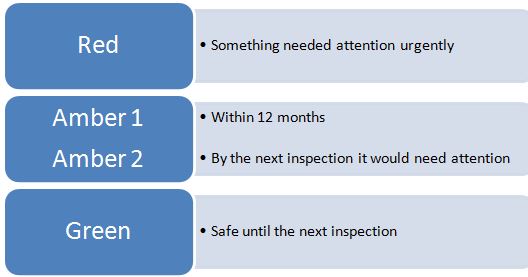
We operate on a Red, Amber and Green system, helping you identify issues that are most urgent so you can plan your maintenance more efficiently.

For example, for one of our customers we had identified a number of staircases within their portfolio that required external painting.
They were able to package together the work so that the contractors could move efficiently from site to site and carry out the work for the lower cost.
Why Use A Structural Engineer To Carry Out An Assessments And Not A Surveyor?
Fundamentally drill towers and external staircases are structures.
If you are looking for a relevant competent person it makes sense that a structural engineer inspects the structure.
A good structural engineer will have knowledge of the actual structure and general building fabric. Drill towers are loadbearing structures, so it’s all structure and a structural engineer would be the most appropriate person to make the assessment.
Generally we are not looking at general building defects, we are talking about defects that affect the structural components – which is usually the basis of safety.
If your structure is failing – that’s a safety issue.
Are you responsible for the maintenance of any external staircases or drill towers?
When was the last time you carried out a Health Check on your External Staircases / Drill Towers?
Why not book a no obligation telephone consultation to find out how we could help you fulfill your Health & Safety obligations. Call us today on 0118 962 9666.
Testimonials
“Having worked well with Michael Aubrey Partnership before, they were an obvious choice to undertake structural assessments of external staircases/drill towers.
They surveyed a number of sites across a large geographical area. Their reports were clear and concise and the “Red, Amber, Green” assessment helped us easily identify sites where remedial work was urgent.
Using this information we were able to plan our maintenance programme in the most efficient way”.
Graeme Major, Estate and Facilities Manager, Leicestershire Fire and Rescue Service
“Michael Aubrey Partnership helped me massively with the assessment of our external fire escapes.
You identified a major risk with the structures of our fire escapes which led to us condemning one of them.
This has ensured that swift action could be taken to mitigate the risk to persons using the structure. Everyone I spoke with was very polite and helpful.
The reports were clear and issued within a short timescale.
I would like to thank you as I know that I added some pressure to complete the report as quickly as possible in view of the seriousness of the findings – thank you. I would recommend Michael Aubrey Partnership to friends and colleagues”.
Boundless by CSMA
Do you have an external stair case that requires a Structural Assessment?
contact us