Overdesign
Most people worry about buildings being under-designed.
But what if the real problem is that they’re over-designed?
It’s something we’re seeing more often, and it’s exactly why we’ve recently been asked to act as Expert Witnesses on a high-value residential project.
The issue isn’t whether the building is safe.
The question is whether it has been engineered efficiently.
Safe doesn’t mean excessive
Structural design codes already include reasonable margins of safety. They have been developed over decades through research, testing and real-world performance.
As Chartered Structural Engineers, our job is to design within those codes.
What we shouldn’t do is add our own extra “just to be safe” safety factors on top.
Historically, some engineers have done exactly that. While it may feel cautious, it often results in structures that use far more material than they need.
The client pays the price.

The £250,000 question
The project we’ve been asked to review involves a substantial private house of around 600–700m².
During the design process, the foundation solution changed from piled foundations to a reinforced concrete raft foundation.
There’s nothing unusual about changing foundation solutions.
What is unusual is the amount of reinforcement specified.
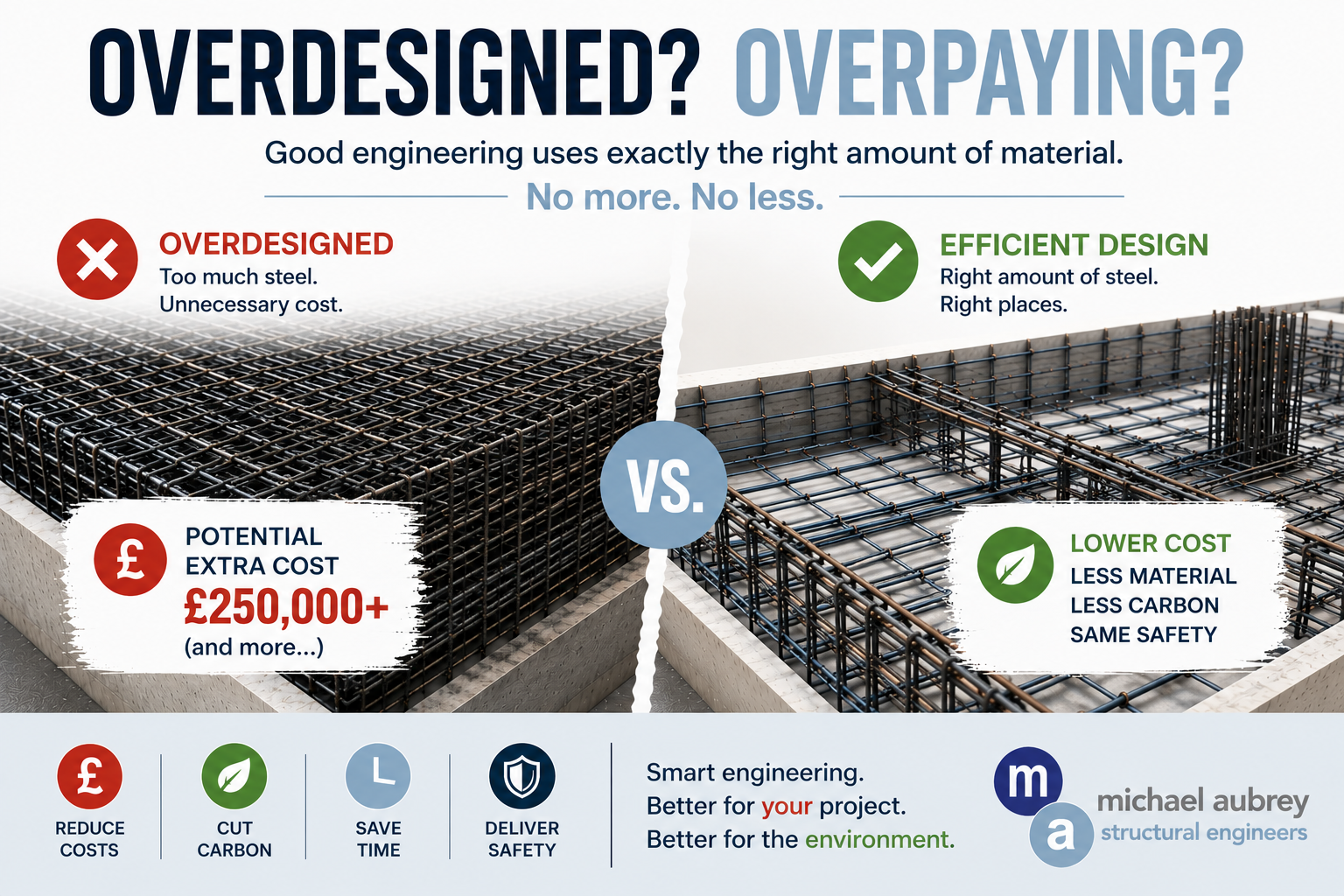
An initial assessment suggests that the additional concrete reinforcement alone could add around £250,000 to the construction cost.
That’s before considering the knock-on effects of additional labour, programme time and embodied carbon.
Our role as Expert Witnesses is to provide an independent opinion on whether that level of reinforcement is technically justified.
Good engineering isn’t about designing everything for the worst case
One of the biggest mistakes engineers can make is designing an entire structure for its most heavily loaded area.
Imagine a floor slab.
Perhaps one small section carries a particularly heavy load. The easiest solution is to specify the same heavy reinforcement throughout the whole slab.
It makes the drawings simpler.
It makes installation simpler.
But it isn’t efficient engineering.
A better approach is to understand where those higher loads occur and provide additional reinforcement only where it’s actually needed.
The majority of the slab may require considerably less.
That’s what thoughtful engineering looks like.
Computers don’t replace engineering judgement
Modern design software is incredibly powerful.
But software only calculates what it’s been told.
If the wrong loading is entered, or assumptions are incorrect, the software will still produce an answer. And sometimes that software can determine a problem that may not be real!
Experience is what tells you when that answer doesn’t look right.
There is extensive published guidance on reinforced concrete design, including typical reinforcement percentages for different situations.
If a design comes out requiring significantly more reinforcement than expected, an experienced engineer should stop and ask:
“Why?”
Sometimes there’s a perfectly valid explanation.
Sometimes there isn’t.
That’s where engineering judgement becomes just as important as the software itself.

Image credits: Terra Contracts
Designing to 100% Utilisation
At Michael Aubrey Structural Engineers, we aim to design as close as practical to 100% utilisation.
That doesn’t mean taking risks.
It means making full use of the capacity that the design standards already allow.
If the code says a member is adequate, there is no need to add another arbitrary margin of safety.
But sometimes for construction it is still the best solution to use slightly more material but simplify design to minimise the risk of site errors, increase repetition and reduce overall cost. More engineering judgement rather than ‘computer says yes or no’ engineering.
Designing efficiently can reduces:
- Material costs
- Construction costs
- Embodied carbon
- Programme time
while still delivering a safe, fully compliant structure.
Efficient engineering is good engineering.
Why does overdesign happen?
There are several reasons.
- Sometimes engineers are placed under intense fee or ‘real-time’
- Clients naturally compare engineering fees and often choose the lowest quote, assuming they’llreceive exactly the same
- Unfortunately, lower fees usually mean fewer engineering hours.
- Less time is available to optimise the design, challenge assumptions or explore more efficient solutions.
- Sometimes the Chartered Engineer wins the project, but much of the detailed design is completed by less experienced staff.
There’s nothing wrong with graduates undertaking design work, they are the future of our profession, but robust checking by experienced engineers is essential.
Without it, opportunities for optimisation can easily be missed.
How can clients protect themselves?
Choosing an engineer shouldn’t simply be about the lowest fee.
Ask questions.
- Who will actually carryout the design?
- Who checks the calculations?
- How is the design optimised?
- What is the engineer’s approach to material efficiency?
It is also worth ensuring your appointment includes a clear requirement for an efficient and economical design, not simply one that satisfies the minimum structural requirements.
That expectation benefits everyone.
Engineering is about solving problems, not creating unnecessary cost
As Expert Witnesses, our role isn’t to criticise fellow professionals.
It’s to provide an independent technical opinion based on engineering principles, experience and current design standards.
The best structural engineering is often invisible.
It uses exactly the right amount of material.
No less.
No more.
Because good engineering isn’t measured by how much steel or concrete you specify.
It’s measured by how intelligently you use it.