
Our third speaker for the day was John Staves, Managing Director at Michael Aubrey Partnership. John is a Chartered Structural Engineer and has worked in the Telecoms industry for over 30 years.

Specialist Telecoms Knowledge

He could be described as a “poacher turned game keeper” as initially, John’s specialist knowledge was gained through working with the mobile operators – he understands the Telecoms market and it gives Michael Aubrey Partnership a unique stand point when representing the Fire and Police Services – providing them with independent, unbiased advice.

John opened his presentation talking about what the drivers were for structural safety, with reference to BS8210 2012. He talked about how British Standards are moving away from being prescriptive to acting more as a “prompt” to think. Allowing you to set out a framework – more of a risk management approach where you;

  • identify hazards
  • identify who could be at risk
  • eliminate, reduce or control the hazard and
  • train those affected by it

Telecoms Condition Surveys

John shared his experience talking through a recent case study where Michael Aubrey Partnership were asked to undertake detailed condition surveys on 65+ drill towers and ancillary structures across the UK.
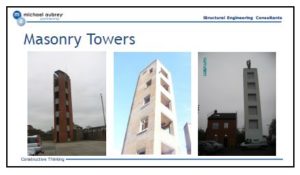
Masonry drill tower


Using a traffic light system of categorisation he was able to help the Fire Authorities identify which structures were in urgent need of repair.

  • 13% of drill towers were identified as being “red” and having defects so serious that they required immediate action
  • Over half of drill towers required maintenance within 12 months

Maintenance Schedule

Ordered by priority, a maintenance schedule was generated which allowed the Fire Authorities to plan their maintenance project around this.

Economies of scale were able to be achieved with contractors, as maintenance programs could be carried out in a methodical, planned way.

Importance of Routine Maintenance

John also talked about the importance of regular routine maintenance.

Whilst unexpected deterioration, damage or failures may still occur, with a regular maintenance cycle you will minimise the need for major refurbishment and repairs

Structures deteriorate over time and will continue to deteriorate if regular routine maintenance is not carried out. Minor repairs and preventative maintenance, should minimise future problems and ensure your structures remain in peak condition.

In summary;

  • Adopt a risk based approach
  • Set your maintenance policy in line with the British Standard BS8210: 2012
  • Adopt a tier based approach with regular inspections and reporting by users, annual reporting by your estates department and specialised surveys every 3 years

When was the last time you carried out a detailed inspection of your property portfolio? If you did, would you find your sites in the Red or Green category?

Our second speaker for the day was Brian Collins, BSC Associates. Brian is a specialist in radio frequency (RF), Radiation, RF measurement and the Health and Safety impacts of RF radiation.

On 1 July 2016 the Control of Electromagnetic Fields at Work Regulations 2016 (CEMF) came into force. Brian outlined the regulations’ requirements and their likely impact in the workplace.

Electromagnetic fields at work

Brian described the main areas that have changed are;

  • There is now a requirement for documentation
  • ALL sources of EMF’s are included
  • There is a specific requirement to consider workers at particular risk

The CEMF requires employers to assess and limit the levels of Electromagnetic fields (EMFs) to which their workers are exposed and minimise the risks to workers arising from exposure to EMFs. This does not include long-term effects.

Any assessment should be recorded and where the exposure limits values and/or action values are exceeded, an action plan should be prepared and implemented.

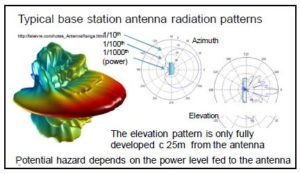
Brian described the typical base station antenna radiation patterns and how you cannot tell how hazardous a situation is, unless you can determine how much power is being fed to the antenna – a visual inspection is not enough.

Base station antenna

Brain described that as an employer you must;

  • Document the potential exposure of your employees
  • Obtain information directly from the radio system operator
  • Insist that operators regularly update their information on potential hazards as Installations for the mobile service are frequently modified
  • Be particularly aware of real danger to employees at special risk

Speaking after Brian’s presentation John Staves said

It is clear from Brian’s presentation that the new Regulations will increase awareness of RF issues and also simplify the ways that property owners can demonstrate compliance”.

How do you think these new regulations will affect you and your business? We’d be interested to hear your thoughts.

Property Managers, Health and Safety advisors and those responsible for property assets, gathered at Leicestershire Fire and Rescue Headquarters yesterday to attend the first in a series of seminars exploring the implications of the new Telecommunications code, RF and Structural Safety.

After welcome and introductions from Duncan Wells, Michael Aubrey Partnership, Thekla Fellas, Fladgate Solicitors opened the seminar examining how the new code will affect property owners.

Thekla talked about why the government feels reform is necessary; citing their commitment to incentivising investment to fully support the rollout of the country’s digital communications infrastructure.

Thekla talked about;

  • How the Department for Culture Media and Sport (DCMS) want to make it faster, easier to secure sites for the Operators – it’s a political decision
  • How it is going to be virtually impossible for landowners to get Operators off their sites
  • How the new telecommunications code will give Telecoms operators access to land – moving to a “no scheme” basis of valuation regime (a  valuation which will favour Telecoms operators).
  • How the new telecommunications code will put digital communications infrastructure on a similar regime to utilities like electricity and water.
  • New rights that will make it easier for telecommunications operators to deploy and maintain their infrastructure
  • Telecommunications operators will have a new automatic right to upgrade and share apparatus
  • Telecommunications operators cannot be charged extra for changes where there is minimal adverse visual impact or burden on site providers.
  • Improved dispute resolution

Telecommunications code

What Impact Will The New Telecommunications Code Have For Property Owners?

The change in the basis of valuation to a “no scheme” rule reflecting the underlying value of the land. Reduced rental income: This will limit the value of consideration that the site owner receives for granting the lease.

When Will this take Effect?

The new Telecommunications Code rights will only apply to contracts signed after the law has come into effect and will not apply to existing contracts retrospectively – transitional provisions are not supposed to be retrospective. The bill is currently scheduled to come into effect in Spring 2017.

Speaking after the event John Staves said

No one is sure what impact this new legislation will have on property owners, but after listening to Thekla’s presentation I think that these changes could well be detrimental to the operators who will find that property owners are reluctant to allow new installations with such sweeping terms. 

It seems really odd that private companies already making huge profits are being given powers which appear to reduce their costs at the expense of private landowners. 

Whilst the intent to make better communications readily available is positive, my concern is that the proposed Code will not achieve this objective and could well slow network development by driving more deals for sites to the Courts for determination“.

Are you a property owner? How do you think this new legislation will have an impact on your property portfolio?